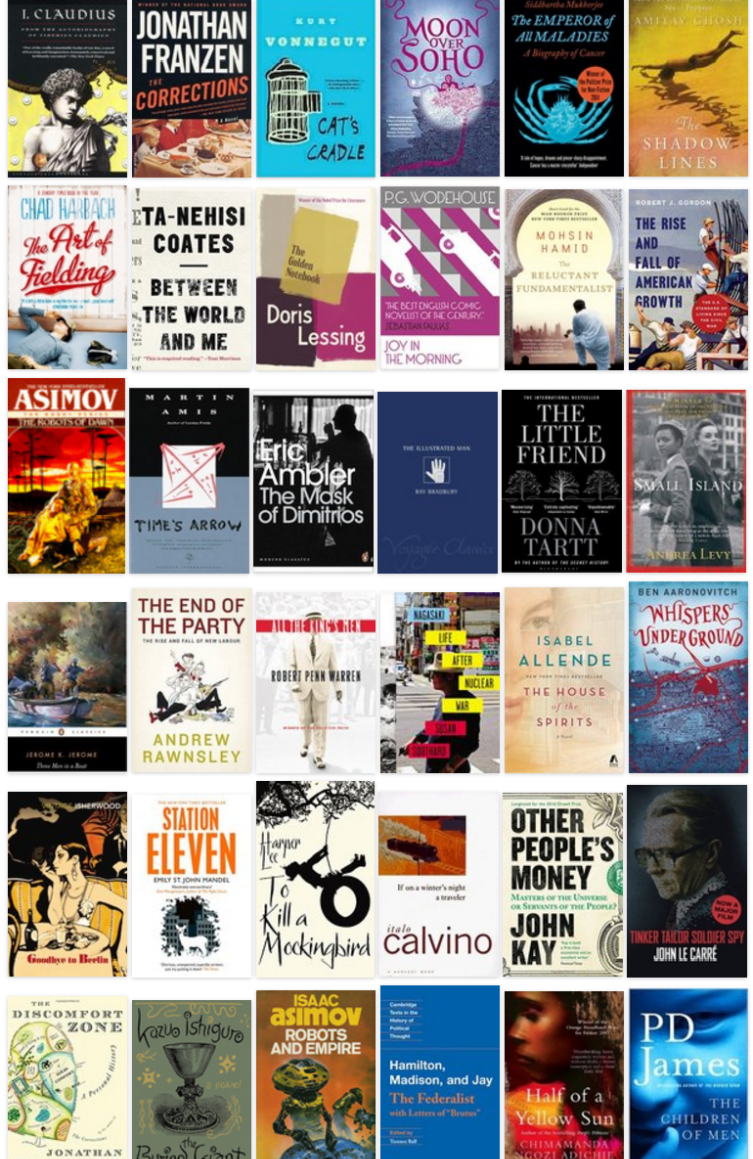
I am really, really pleased with the books I read in 2016. And I tried to get better about making some quick notes as I did so… partly to remember more, and partly to make writing this review easier at the end. Let’s see how well I did!
My first book was I, Claudius, an incredibly bloody underdog story gifted by Todd. (Spoiler alert: just about everybody is murdered by the end.) Other Todd-influenced reads this year included The Corrections, an absorbing family drama and ‘state of the nation’ book, and The Art of Fielding which left me forever fearful of getting struck in the face with a baseball. It’s an interesting story because every single character is basically good and well-intentioned, yet everything falls apart anyway.
I also had high hopes for The Little Friend but found it much less cohesive than last year’s The Secret History. That said, many of its scenes and characters have remained vivid in my memory – Hely trapped in the apartment with the snakes, for example – and my research for this post suggests the murder-mystery aspect isn’t left quite as unresolved as I had thought. The main character, Harriet, has an obvious forerunner in To Kill a Mockingbird‘s Scout: a classic child’s-eye perspective which I finally read this year.
I really loved reading Asmiov’s Robot series, more so each time, which I concluded this year with Robots of Dawn and then Robots and Empire. Not only was the latter a well-timed piece of post-Trump escapism, but it also serves as Asimov’s bridge between previously distinct series, and I am eager to keep going next year. It also took some effort to limit myself to reading two of Ben Aaronovitch’s moreish Peter Grant series (Moon Over Soho and Whispers Under Ground). It’s hard not to love something infused with so much London. The Illustrated Man was another collection of Ray Bradbury’s wonderful (and mostly creepy) short stories, tied together with an unsettling framing device.
After a weaker Ishiguro last year, The Buried Giant was one of my favourite books of 2016. Following the journey of two elderly Britons, Axl and Beatrice, the book is set in post-Arthurian Britain (a time period I rarely think about) in which memory is mysteriously suppressed and an uneasy peace holds between Britons and Saxons. Its opening was so intriguing and the book held me rapt throughout. For fans of Ishiguro’s style, this is highly recommended. And on subject of Ishiguro, The Reluctant Fundamentalist is aptly compared to The Remains of the Day for its gripping first-person narrative style which drives it towards a suspenseful thriller of an ending.
Another of my favourites this year was Station Eleven, a good old-fashioned post-apocalyptic dystopia (plus travelling Shakespeare troupe) which I raced through. Cat’s Cradle was a much better Vonnegut than my last attempt, and the concept of a granfalloon actually occurs to me a lot now. Time’s Arrow, a novel in which a Nazi doctor’s life runs in reverse, will mess with your head and convince you that real life is also running backwards. And I was initially very into the postmodern If on a winter’s night a traveller although there is something undeniably frustrating about a succession of cliffhangers from different imaginary books, even if the ending comes with a nice ‘a-ha!’ moment.
I feared getting lost in the magical-realist epic The House of the Spirits but was kept engaged by the intertwining of real Chilean history, which I really appreciated learning more about. Similarly, I learnt about Biafra and the Nigerian Civil War in the 1960s through Half of a Yellow Sun, Chimamanda Ngozi Adichie’s engaging but slowly devastating book about the conflict. All the King’s Men wasn’t quite my style, but is apparently modelled closely on an interesting figure in Louisiana political history. (Oh, for the days when a populist American demagogue would at least build some hospitals.)
Turning to non-fiction, The Emperor of All Maladies – billed as a ‘biography of cancer’ – taught me so much about a vast subject which I had never really considered before. Perhaps the most important lesson is how unstraightforward medical ‘progress’ is. You might imagine that the history of cancer treatment is one of slow, incremental improvement… but it’s just much more complicated than that, with many intellectual dead-ends and ‘breakthroughs’ which come with horrible trade-offs. And yes, I did read some of this on a beach.
Prompted by Brexit, it felt like the right time to revisit the New Labour era in Andrew Rawnsley’s gossipy The End of the Party which documents the full destructive force of the Blair-Brown relationship. It seems like such a long time ago now. The Rise and Fall of American Growth was a much drier read, as you might expect from economic history, but it makes one side of an important argument about the uniqueness of the twentieth century. It also led to me boring people at work for weeks with random factoids, for which you can blame ‘The Weeds’ podcast for recommending it in the first place. One annoying spot in a generally magisterial work, albeit sadly common to many discussions, is the breezy assumption of ‘more marriage’ as a social good with no real nuance or consideration.
It was also good timing to read The Federalist (with the opposing Letters of Brutus, which makes some prescient predictions about the Supreme Court) straight after the election, at the very moment when Hamilton’s Electoral College defence started popping up all over Facebook. The Papers were written to urge adoption of the newly written US Constitution and defend it from accusations that too much power was being centralised, which puts me in a weird position as someone who looks at two-year terms in the House of Representatives, for example, and thinks ‘that’s absurdly short’ as opposed to ‘that’s long enough for tyranny to strangle the liberty of the people’. So I guess it made me more sympathetic to the Constitution (never my favourite document) as an achievement over nothing at all.
But a more important perspective on these events can be found in Ta-Nehisi Coates’s Between the World and Me, a series of letters to his teenage son about the history of race in America and what it means for him. This is somewhat difficult to write about, given that only yesterday I heard Coates speaking about his frustration that the unexpected popularity of the book amongst white liberals ends up hurting his ability to write and think and explore freely. And we need that. So I will limit myself to the two most memorable things which I took from this book, which you should read. One is the moral clarity that people in the past “didn’t ask to be your martyrs”: pain and suffering by some cannot be ‘made good’ to others. The other, more personal, is his description of an incident with his five year-old son on an escalator. It is one of the most powerful things I have ever read.
Rounding off the non-fiction was Other People’s Money (a persuasive reminder that we have far more financial activity than we need) and Nagasaki: Life After Nuclear War. Susan Southard’s account of the 1945 atomic bombing, and the lives of its survivors, was at times so horrific that I had to stop reading it on a plane for fear of passing out. But it is a worthy discussions of events which are usually discussed in the abstract.
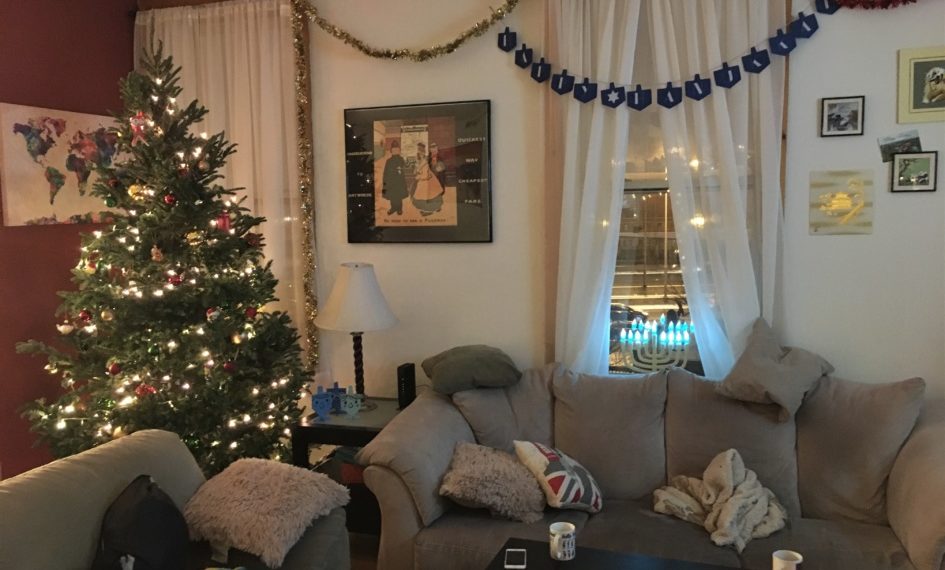
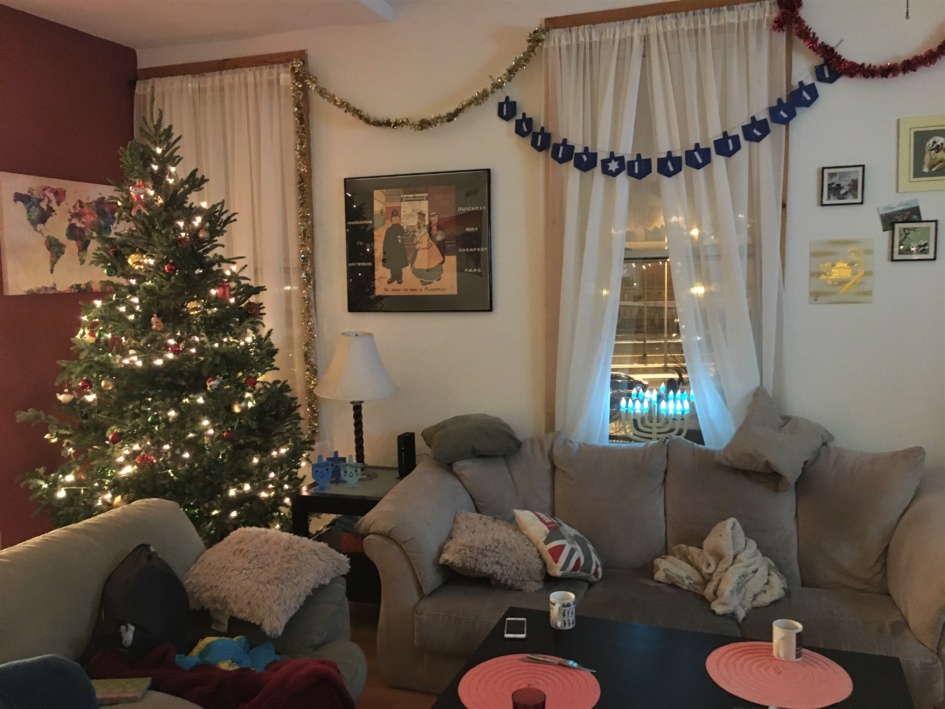
Chrismukkah
It’s that time of year again: snowy and cold outside, pretty and festive (but hard to photograph) inside. Carrying the Christmas tree home was a much less stressful exercise than last year’s gargantuan effort, but it still spruces up well. Together with the Hanukkah decorations we had a suitably seasonal living room to host many guests bearing board games, although on many occasions we tricked them into watching Planet Earth II with us instead. Because it was just so good.
Outside of the Chrismukkah base we also went to Randi’s work holiday party (and bounced on a trampoline with her CEO) as well as Robert and Julie’s mirror-image apartment housewarming, Alex’s holiday party at which gluhwein was served (very exciting) and Ellen’s ‘Master of Peppers’ chilli-making competition. Importantly, one is not required to actually cook a chilli in order to attend. I was very sad about missing this last year so it was great to finally return and meet baby Edy for good measure. (Chilli #10 was the best by some measure, in case you were wondering.) We also attended an inaugural D&D game at our neighbours’ flat across the hallway: nothing has felt more back-to-university than being able to return home for the night by just walking between apartments.
Finally, I also had great Motel Bar sessions with Alejandro and Teresa, and also saw Rogue One and Arrival. I put Rogue One in the bucket of ‘perfectly enjoyable but nothing special’ – not as good as last year’s Star Wars outing, although it does finally explain why the Death Star is so easy to destroy. But I really, really enjoyed Arrival. It’s a thoughtful science fiction film which takes seriously the problem of language between humans and aliens, and I thank Todd for wanting to see it with me after a cheeky Nando’s.
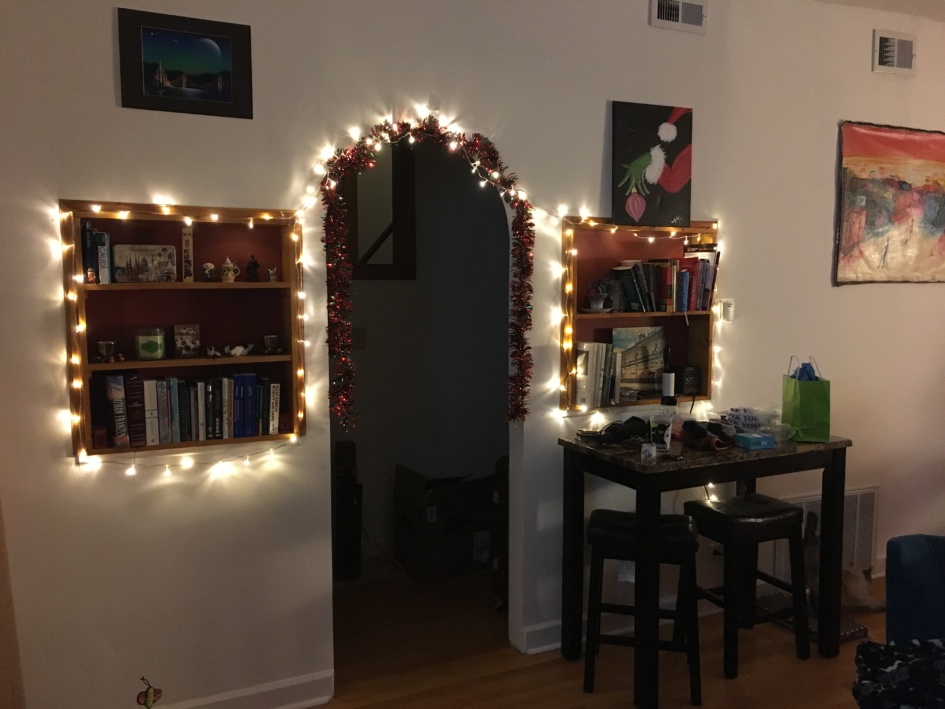
You can never go wrong with more lights
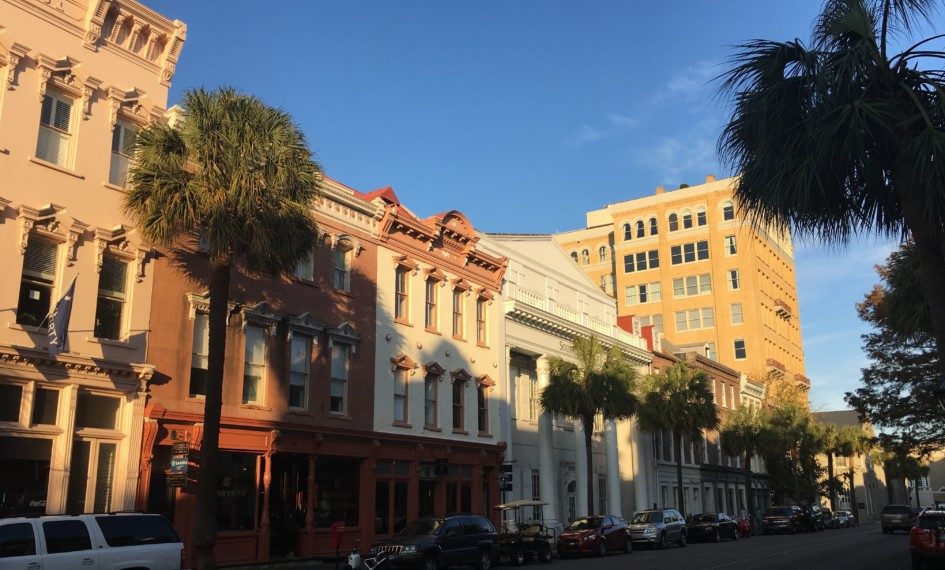
For my traditional (?) post-Thanksgiving trip with Randi this year, we went to Charleston, South Carolina.
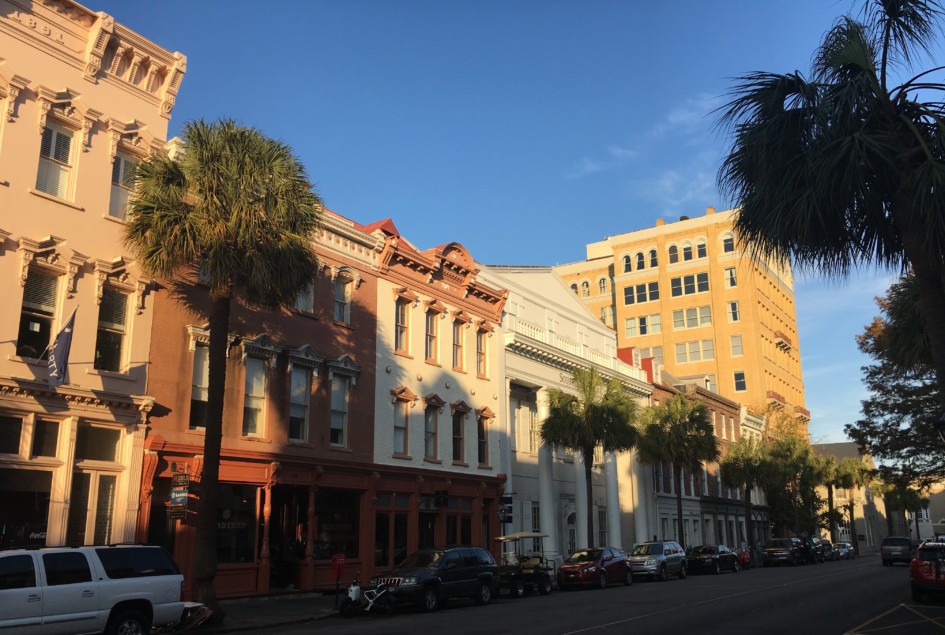
Charleston really is beautiful
Charleston really is a beautiful city, and such a joy to walk around – not just because the sun was out. Our AirBnb was a 40 minute walk from the centre of downtown, through mostly quiet, residential streets, but all along the way we passed local shops and bars and restaurants and people. The contrast with some of the Midwestern cities I’ve visited recently is obvious. And sure, Charleston is a tourist destination: an old city steeped in American history and blessed by a core of old money and narrow, pre-car streets. It is supposed to be nice. But it really does live up to it.
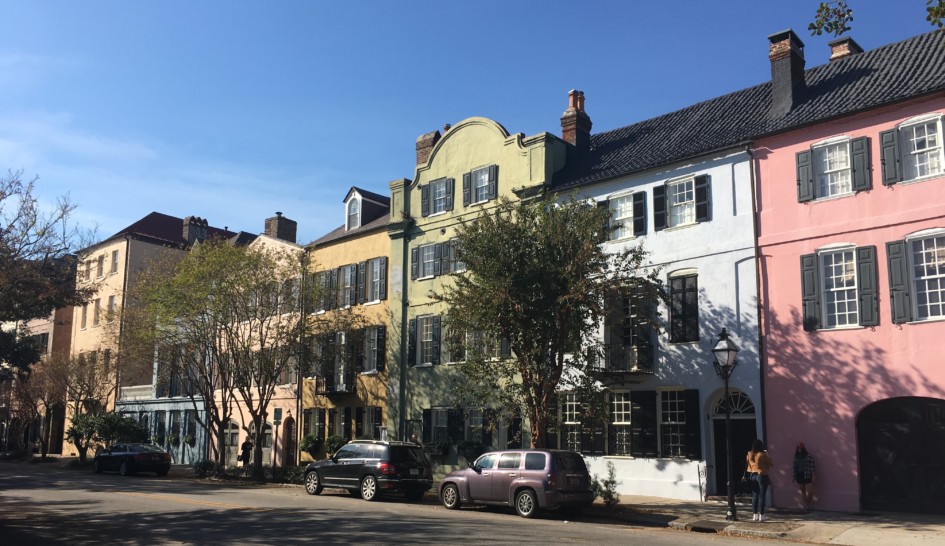
Rainbow road
The best decision we made was to take a walking tour, led by Scott and highly recommended. He gave a great introduction to the city’s history – from its founding as an English colony to the place where the first shots in the Civil War were fired – and didn’t shy away from the story of the native Americans, or enslaved African Americans, which are a fundamental part of it.
We also ate at slightly-pricey-but-delicious restaurants (many thanks to Cecelia for recommending The Hominy Grill, which we visited twice) including honey-coated crawfish hushpuppies, amazing crab cakes and southern fried chicken. And on Friday night we enjoyed the Que d’Keys Duelling Piano Bar – highlights include a reluctant Miley Cyrus cover and discovering that the woman behind the bar was from Bury St Edmunds. (It was also the first and only time that my ride home has been in a pickup truck.)
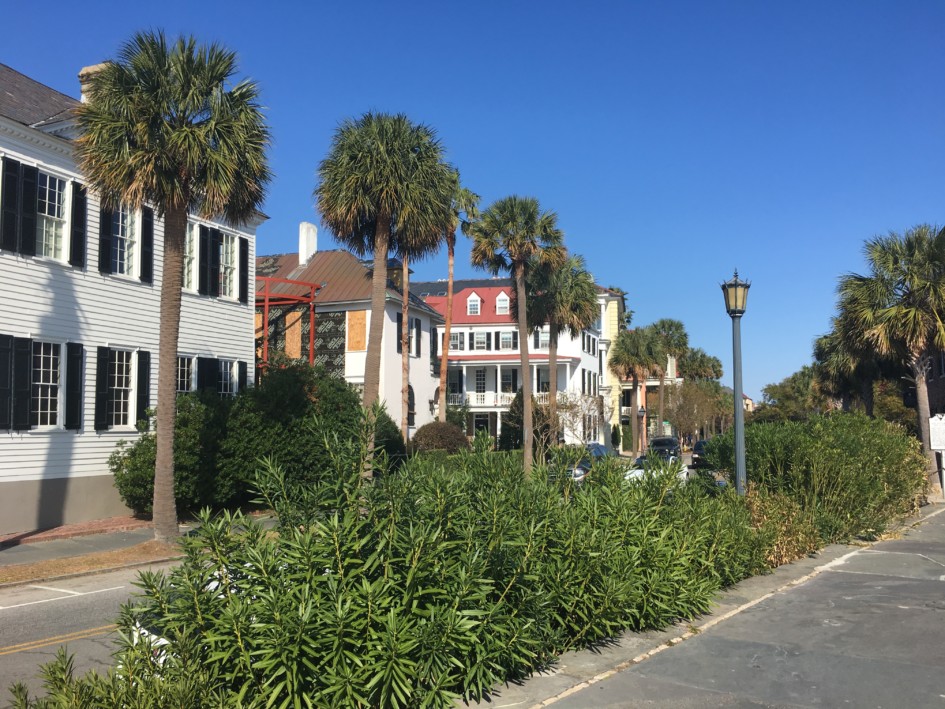
The sabal palmetto trees are everywhere
But we also wanted to visit a former plantation, eventually deciding on Middleton Place. This is where my feelings are mixed, and I still don’t exactly know what to make of it. Because I cannot imagine a plantation as being about anything other than slavery. That’s the purpose of preserving it as a historic site: to ensure the past is not forgotten, and provide a place where it is talked about, especially with children. Maybe that’s a bad starting point, and it’s just a way to compartmentalise the past and keep it out of mind beyond certain designated places.
Either way, this is clearly not what the owners of Middleton Place think they are doing. As you would expect from the former gardens of very rich people, the landscape is beautiful, and seems to be why people come. We had to assemble at #22 on the map for the slavery-focused tour, and while it’s hard to articulate exactly what was wrong, it just didn’t do justice to how sober the subject should be. It was more of a historical curiosity, safely removed from the present day. No slave cabins have actually survived: #22 on the map was, in fact, constructed after the Civil War for returning slaves coming to work as sharecroppers. This would have been a good opportunity to talk about the legacy of slavery after 1865, but we didn’t. And starting a tour by saying that slavery “has existed for millennia” and “is not just a Southern institution” is not the best way of taking on the responsibility for telling this particular chapter of human history.
I don’t want to suggest that our guide was an apologist for slavery. She wasn’t. She described what happened and answered questions honestly and it could have been a lot, lot worse. But it also could have been better.
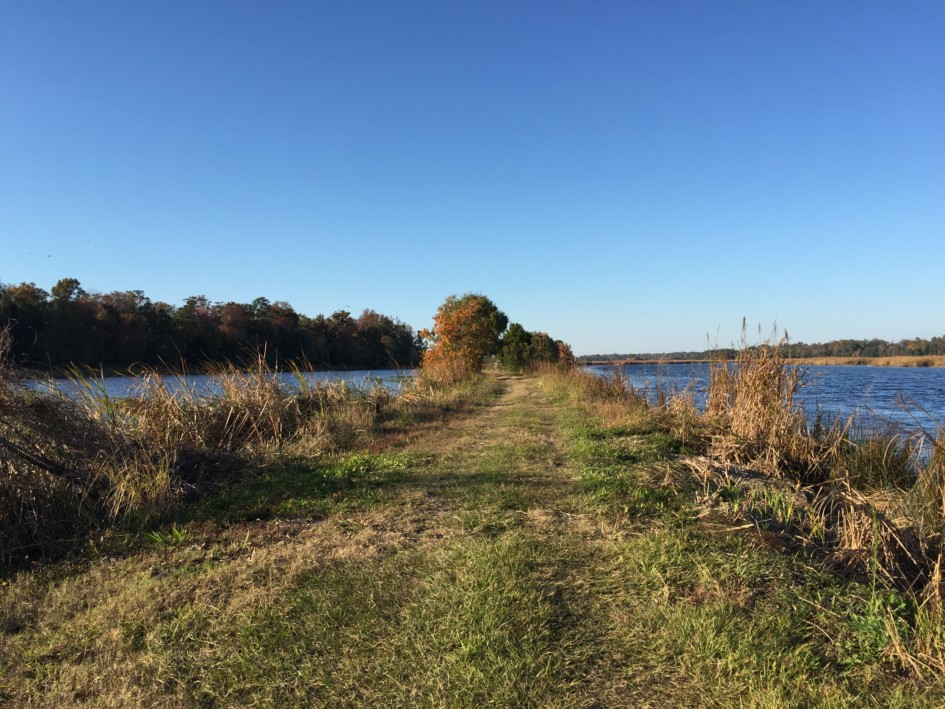
Don’t walk down this path. Trust us.
After the tour, we walked down this narrow strip of land – which we probably weren’t supposed to – and Randi almost got eaten by an alligator. So there’s that.
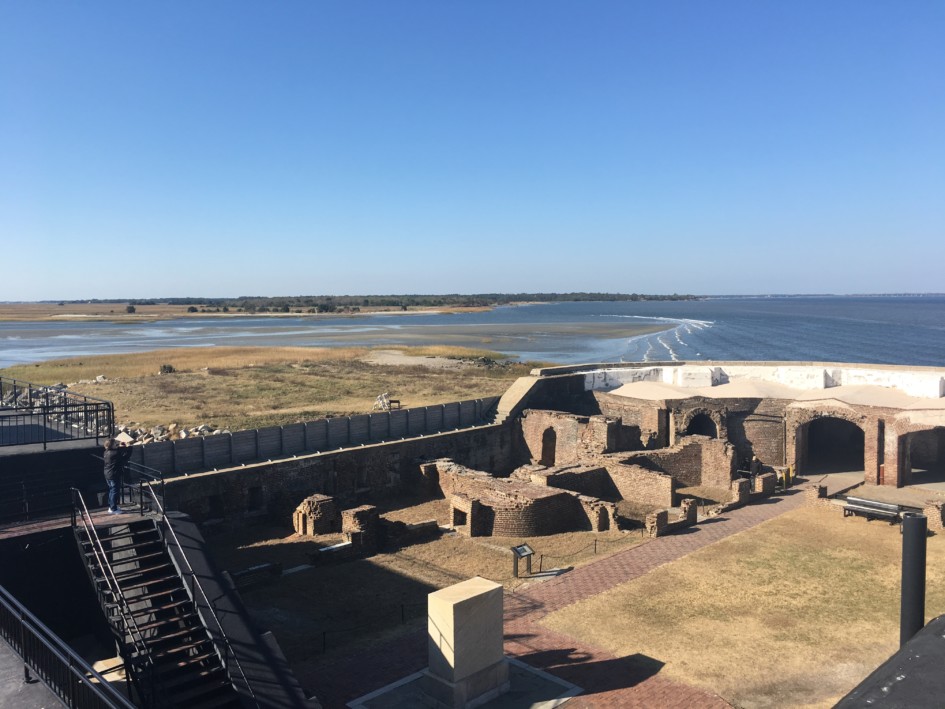
The remains of Fort Sumter
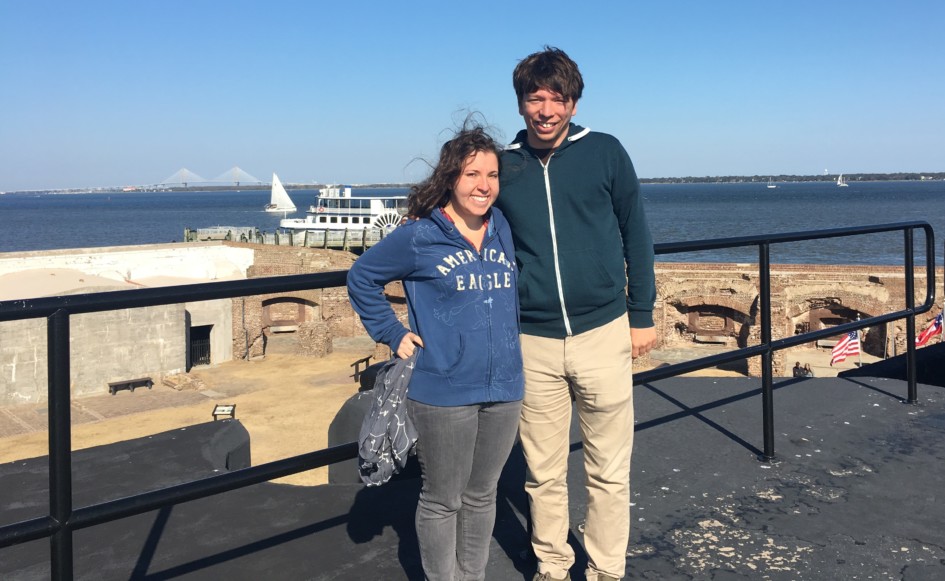
Holding the fort
For our final day in Charleston, we visited Fort Sumter. History lesson: South Carolina was the first state to secede from the Union at the start of the Civil War, and later fired the first shot at Fort Sumter where the US Army had hunkered down. Built to withstand the British navy coming from the sea, it wasn’t really designed for an attack in the other direction and they eventually surrendered. Only the base of the structure remains today, but it is a good place to sit and look back at Charleston over the water and be alternately grateful and afraid.
Happy Thanksgiving!
Fruit Ninja
We all have this feeling sometimes
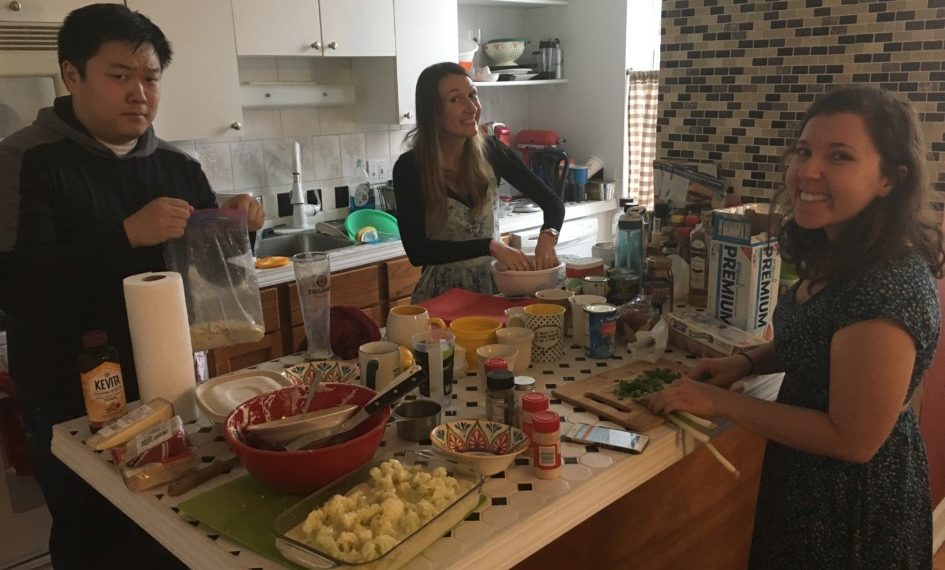
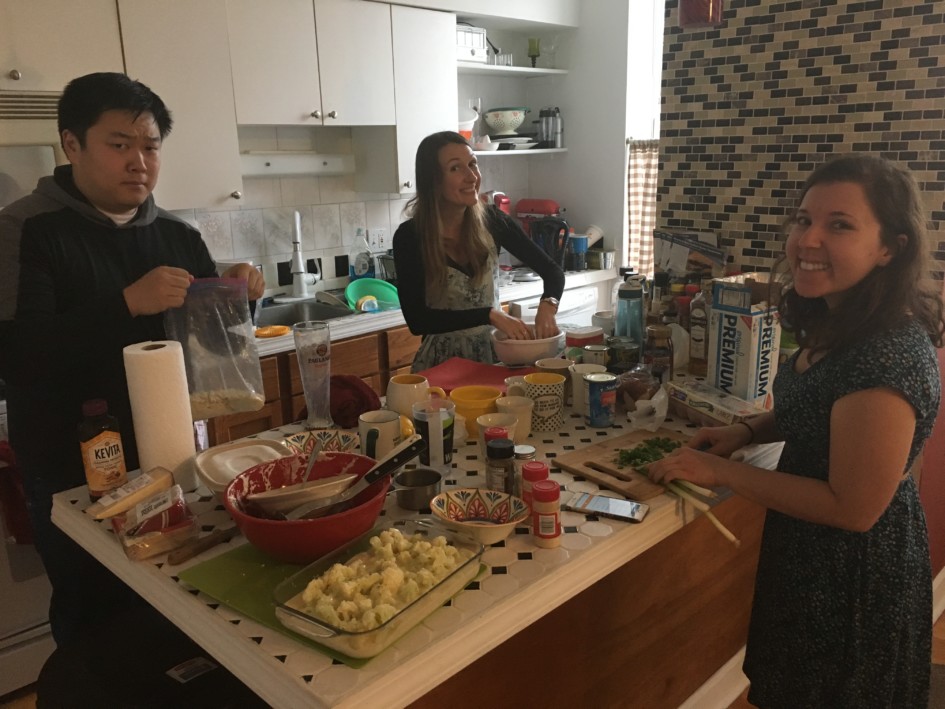
Today was my fourth Thanksgiving but the first time I co-hosted. Thank you to our flatmate Amanda for being so great, and for her mum for coming to see us. Thank you to Jason for being my stalwart Would I Lie To You teammate and to Cat for standing behind me several years ago in Drayton Park and making it very clear the right and the wrong way to make a cheese sauce for cauliflower cheese. I’m sorry I couldn’t remember exactly which was which, but it worked out in the end!
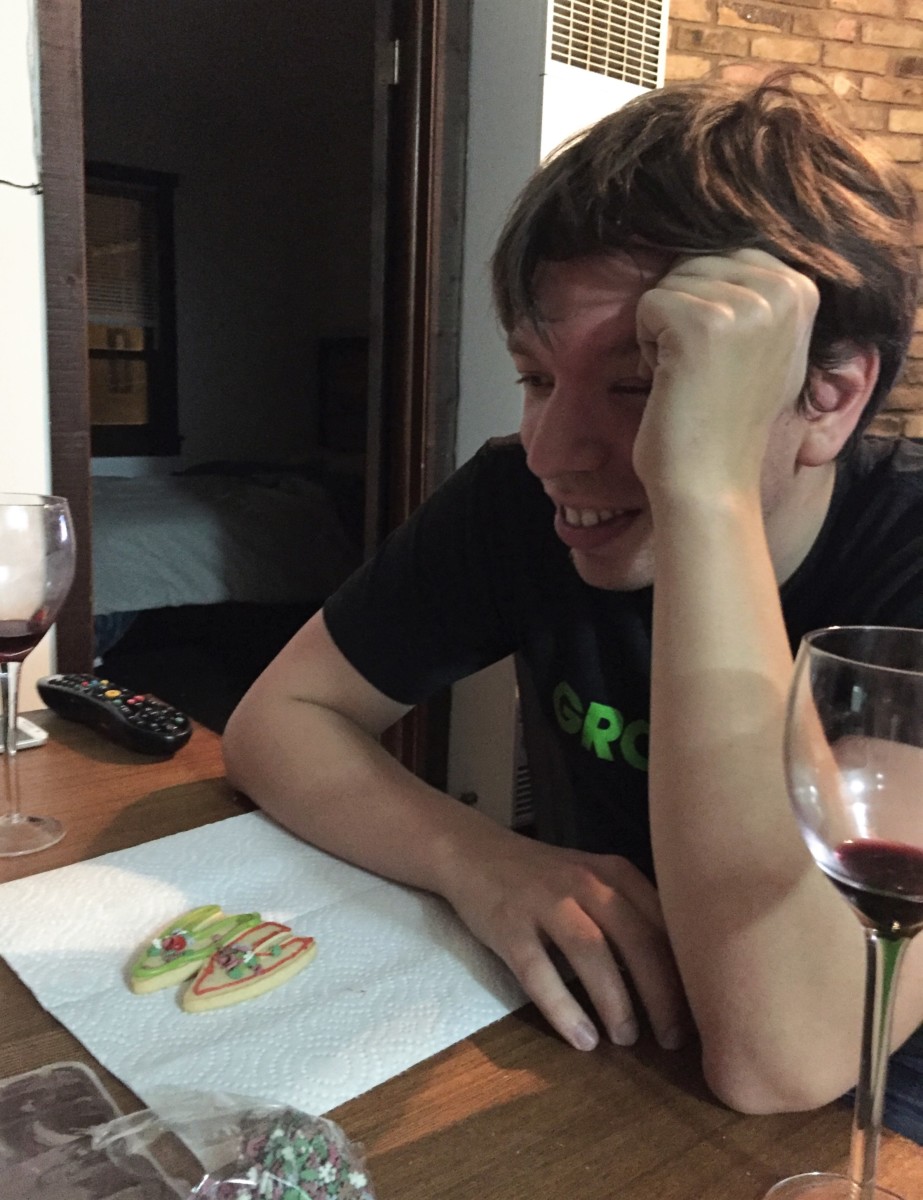
Also had a lovely evening with Catherine and AJ earlier this week, decorating ugly Christmas sweaters/jumpers (in cookie form) and drinking lots of wine. I can’t remember exactly what made me pull this face, but it may have been the lack of American instinct for innuendo.
Happy Thanksgiving!
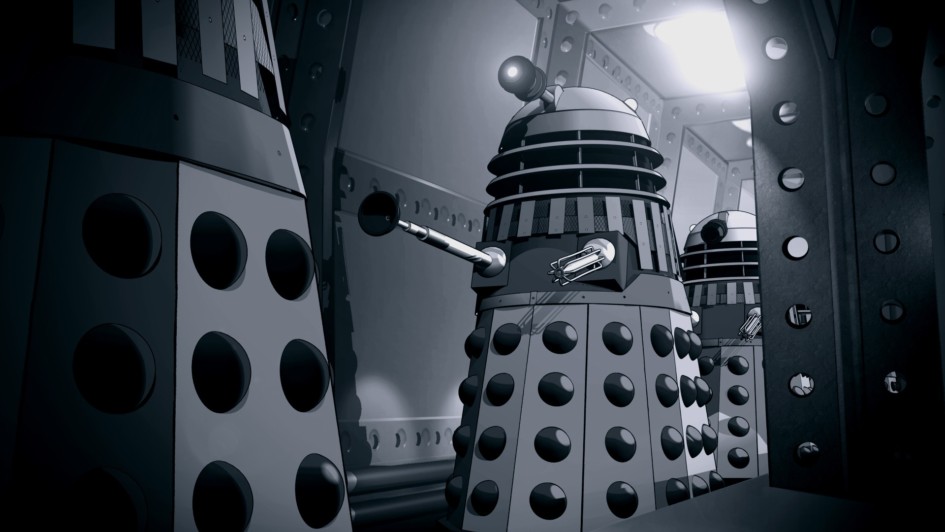

The Power of the Daleks ©BBC
Good distractions from the unfolding political nightmare:
- Watching the animated reconstruction of Patrick Troughton’s first story, The Power of the Daleks, in the cinema. Actually, I also enjoyed just focusing on the audio and trying to hear it in the living room where it was first broadcast and saved 50 years ago. The story itself was silly but menacing nonetheless, with sneaky Daleks ready to lure credulous humans into with extravagant promises of 100% reliable weather forecasts. And then killing almost all of them.
- Introducing James to Four Lions. I do love that film.
- Playing Pandemic with Randi, Chloe, Aaron and Jason. I was sceptical of cooperative games but this really won me over, even though we were unsuccessful in saving the world from destruction. (Damn you, South America!)
- Finally seeing Catherine and AJ again now that the campaign is over, and trying to uplift ourselves with multiple episodes of The Secret Life of 4 Year Olds. (Conclusion: 4 year olds are frighteningly advanced.)
- Laughing a surprising amount at three improv comedy teams with Randi’s colleague Katie at Friday Night Riot at the Bughouse Theatre. (Perhaps I shouldn’t have been surprised, but for $10 tickets at a tiny theatre on a Friday night I wouldn’t necessarily expect to be laughing out loud rather than smiling indulgently. Legitimately funny.)
- Lunching with Luis while keeping an eye on two football matches (real football!) and pooling our limited knowledge about the political situation in France. It would really be a good idea to keep an eye on France.
- Joining the adorable adventures of Newt Scamander and his TARDIS briefcase by seeing Fantastic Beasts and Where to Find Them with Todd and Carolyn this afternoon. (Although I do share Todd’s concerns about the continued absence of any proper judicial process in the wizarding world.)
If you’re looking for more productive things to do, I am reliably informed that phoning your representatives (not writing or emailing) is the most effective way to lobby them into investigating Trump’s evident conflict of interests, challenging his frightening and unqualified appointments, and generally causing a fuss. (I haven’t done so yet, partly because none of them are really ‘my’ representatives. But I should.)




 Linda Moffitt on Colombia: “Such a sweet memory of the four of you meeting up in Colombia!” Dec 2, 07:42