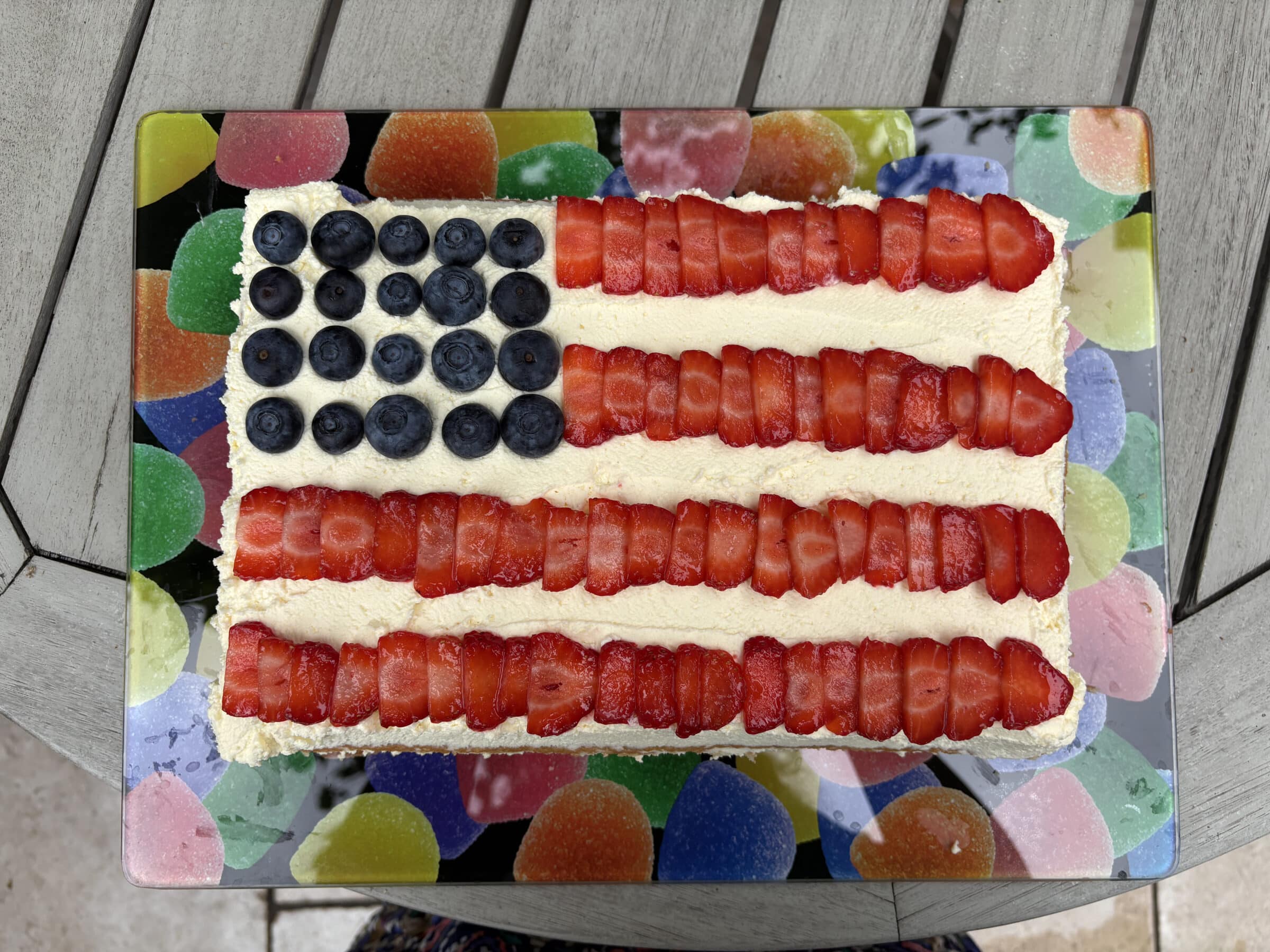
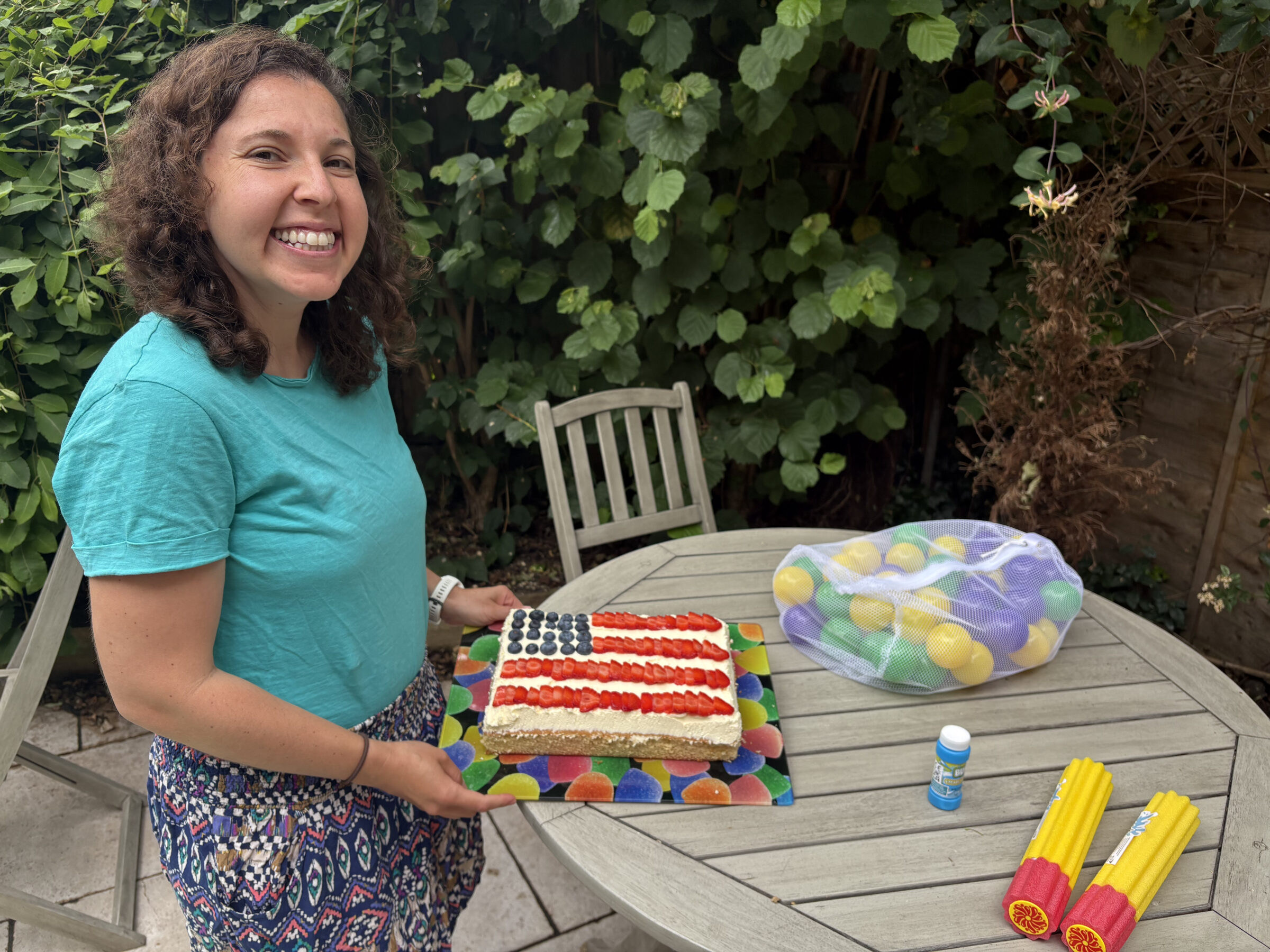
I am half-watching the World Cup final as I write this, honest. But there’s a lot to catch up on, starting back in late June when Reema came over for dinner and took some inaugural bites of the magnificent chocolate fudge cake which Randi had concocted for my birthday. Since we have a strict one-in-one-out policy when it comes to cake in this house, this birthday cake had all disappeared by the weekend when Randi produced her second, all-American cake for our Independence Day NCT gathering on 4th July. (I’ll gloss over the slightly worrying questions which emanated from the kitchen during the decorating process, like “how many stars are there on the flag again?”)
[Update: Spain vs. Argentina was clearly such a gripping match that I only managed to complete a single paragraph last night! Therefore, I am officially now writing this in our post-World Cup 2026 future.]
In addition to Randi’s cake, our paddling pool was the other big hit from our NCT meetup, where it played host to three sedately splashing babies. The next day it was transformed into the central battlefield of a much darker and more warlike affair, as Kirsty and the girls visited and I was thrown into a defensive battle against two agents with water soakers. (I should have learnt from Kerensky: never arm your opponents.) That said, I was pretty pleased with my makeshift counter-offensive courtesy of the garden hose, and once everyone was properly drenched we did manage to reach some sort of uneasy peace settlement. For now.
This is surely the kind of play of which the makers of Toy Story 5 would approve. I snuck out one evening to see this with Tash at the Genesis Cinema in Whitechapel (*makes mental note of how convenient this location is*) and I think my reaction is the same as many others: it’s great fun, but at this point the series seems firmly targeted at Toy Story millenials like us rather than the younger generations. My countercultural take, however, is that while this film is formally about the intrusion of screens and technology into wholesome childhood play (although maybe don’t think too hard about how all of these plastic toys were themselves an erasure of what came before but that’s another story) its real message is about something much simpler: girls and girlhood.
Spoilers for those who haven’t seen it: eight year old Bonnie happily plays make-believe with her toys but struggles to make human friends. In an attempt to help her socialise, her parents buy her a ‘Lilypad’ tablet, complete with lots of games and social networking features. This immediately displaces all of Bonnie’s imaginative play, as instead she becomes hooked on trying to win the approval of a group of girls from dance class. They spend all their time on their own tablets, even when they’re all together, and mock Bonnie for holding on to her toys like a baby.
I’m no apologist for social media, and children all huddled around screens is almost as depressing as adults huddled around screens. But the basic story here – about wanting to fit in, seem grown-up and put away childish things – could have been told about any previous generation. One reason why many of us are so conflicted about the current technological hellscape in which we now live is that while it’s easy to be nostalgic for the shared cultural moments we’ve lost from a more monocultural era, none of us actually want to give up our tailored and personalised entertainment (our shows, our podcasts, our trusted news stories) which have now been unlocked. And the same may go for friends, too.
Indeed, as Toy Story 5 itself rather slyly points out, Bonnie is ultimately rescued from her misery because Lilypad is able to connect her to another creative, imaginative kid who lives out on a farm. Without the screens, they’d never have met. In some ways, therefore, it should be much easier now to resist the dance class clique. There will always be some group who thinks your toys are cool! In practice, I think it’s clear that things don’t really net out this way, and most of us would still be better off having more artificial constraints on an endless stream of screen-based entertainment and socialising. But 1960s or 1990s Bonnie would still have faced the same basic social dilemma, albeit perhaps not as relentlessly or invasively as via a screen which follows you everywhere.

I can’t remember if we talked about Toy Story specifically, but Sanna and I definitely ran through a wide range of parenting topics during our lovely midweek lunch during one of her rare flying visits to London! (Until next time, we’re also trying out the bizarre-but-clever Roost app to exchange messages via pigeon.) That weekend, I also had dinner with Andrew and Bonnie before the three of us saw Springwood at the Hampstead Theatre courtesy of a joint birthday gift from mum to the three of us.
This play is tightly scoped in both time and place: the visit of King George VI, and his wife Queen Elizabeth, to President FDR’s New York family home in June 1939. It’s a brief diversion from the couple’s royal tour of Canada and not a happy one, as Britain’s accidental and reluctant new King (yes, the one with the stutter from The King’s Speech) struggles under the immense burden of trying to secure Roosevelt’s support for the upcoming war. Meanwhile, his insecure Queen bristles at many perceived slights and humiliations from their hosts, and in particular at the indignity of being ‘forced’ to eat hot dogs in public at the picnic which Roosevelt has organised in their honour.
An awful lot is made of this hot dog business, but suffice to say this all really happened, and it was only during the short scene at the very end where this part of the play really clicked for me. We see the secondary characters gather together to listen to the voices of the principals offstage, and their immense relief when this silly hot dog eating photo opportunity goes off smoothly for the press. Because, of course, in an age of broadcast media these contrived ‘moments’ can have great symbolic significance, even if the effort and emotion which goes into them feels grossly disproportionate.
Until this point the play was somewhat uneven: the first half was a bit slow, but it picked up after the interval. The cast was stellar (Robert Lindsay as FDR! Jemma Redgrave as Eleanor Roosevelt!) although the accents were wildly inconsistent from sentence to sentence. I haven’t really touched on the domestic heart of the story – which is essentially the King and FDR bonding over their shared physical limitations – although the presentation of the Roosevelt’s ‘open marriage’ seems a little bit of a stretch. The pairing of a ceremonial head of state with a political master is an intriguing one, and I’d like to have seen them go further with it. Still, spoiler alert: FDR did (eventually) take the US into the Second World War and Britain was saved. All’s well that ends well.
[Update #2: All of this endless rambling has resulted in very slow blogging progress. So, I’m going to take Tash’s advice and push the publish button long before we’ve caught up to the present day. If this spirals out of control and I fall further and further behind, we can blame her!]