Ladies and gentlemen, from a chilly Cambridge attic bedroom, I wish you a good evening. My plan is to blog, quickly and quietly, before retiring to a still-considerably-cold bed. Tomorrow morning brings a mock exam for HAP – ‘Historical Argument and Practice’ – which is the seemingly obligatory part of any course where everything goes tediously meta, and questions run the gambit from “But, really, why?” to “So what?” and “Oh, right. Discuss.”. But never mind. If I really can’t think of anything to write, and bear in mind we have three hours to come up with a single answer, I might just resort to composing limericks or something. It’s a mock.
Much much much more fun is my actual paper this term, which is a continuation of the history of political thought from last year. This week is Hume, who is awesome, although I am slightly concerned that the rest of the term is going to be a downward spiral from this initial height. (It’s hard to improve on ‘no metaphysics’, since just writing it again but in a bigger, jazzier font is bound to be subject to diminishing returns. Maybe in <marquee>…*) Anyway! All this has lead to a grand moment of self-discovery tonight, wherein I realised that my answer of “I don’t know, I don’t have any plans…” to questions about the future is basically a lie. I do have plans – lots of plans! – only they’re based around reading rather than careering. So, here is my commitment: when I leave uni, I am going to make time to read (a) even more philosophy, (b) Very Short Introductions to sciencey things and (c) great fiction. Inbetween, if I have time, I might get a job. How’s that? 
(If only I could read on trains, my life would be pretty much complete!)
*Note to self: It’s probably best not to write jokes which combine both philosophy and HTML, since the potential target audience reading this blog is basically Alex Trafford. And maybe Bill Thompson.

Short of time? Next year, don’t bother to read the blog… you can always wait for the grand and over-stuffed review of the year.
January
Traditions, traditions! SexFest ’09 may have innovated by ditching pillows for balloons this year but was otherwise its usual big, bold and thoroughly mad self. The month it inaugurated, however, was unusually bumpy and stressful: Themes & Sources nearly gave all of us at uni a collective nervous breakdown, whilst Lucy and I broke up… but more of this later, in a happier month. And there were still plenty of good things, naturally! Like meeting Niamh for the first time, gathering around the radio to listen to Obama’s inauguration, Tash coming to visit and see Milk, starting political thought (yes, really  ), luring others into coming to Caius formal and [drumroll, please] joining Twitter!
February
In amongst the snow, Lucy and I got back together  so all was well again! (Plus I ended up trying to read Aquinas on a packed train trudging across the country.) Meanwhile in February, I was shadowed around Cambridge by an eager Sixth Former in a reversed echo of three years earlier, Oliver received his EMPEROR t-shirt (don’t ask) and we all saw the feel-good Slumdog Millionaire, plus enjoyed the second History Society dinner. Oh, and Thomas Hobbes and I like totally clicked.
2009: full of good food and great people
March
So many lovely March evenings: Peggle and music with Abbi, vanilla tea and absurdist theatre with Sona, Crisis Control and Darkplace with Lucy, Watchmen with everybody. As term ended I finally got round to doing a lot of things I should have done much earlier, like go swimming with Abi in the pool right opposite where we lived, pin down Bill Thompson for lunch and fall in love with Buffy the Vampire Slayer. Once home there was just about time to chill out in the Blues Bar – and let loose a new and improved Feed Mix on the world – before Lucy and I were off a procession of carefully timed trains to the Yorkshire countryside and the picturesque Crakehall Watermill! Whereupon, on the final day of March, I fulfilled my central aim in life by visiting a cheese factory.
April
We continued to Leeds – eating (slow) pizzas with Andy, visiting the best ‘art’ gallery ever and enjoying The Tempest – before coming home in time for me to make Robert’s warm, cosy and well-catered dinner party. In April we also crowned Oliver champion as my dream of Peggle ‘n’ Pizza became a reality, whilst I rode the DLR, got round to visiting the Lexi, took the plunge in watching Twilight and ended up quite unexpectedly immersed in a piece of pub-based theatre one night with Sanna’s family. Once term started, however, it was back to the rather less relaxed world of revision, not-doing-revision-when-you-were-supposed-to and talking-about-both.
May
In May I saw what was possibly my film of the year, In The Loop, and got more in the real-life loop vis-à-vis the ever-wonderful Sophie. There was also waffle consumption with Sanna, State of Play, middle-class Monopoly with Kat, and what was possibly my runner-up film of the year, Star Trek. Twice . Andrew’s politics dinner brought the opportunity to ask Cornelius about ‘happiness lessons’; Space Mutiny (the film of my life) brought the dastardly Kalgan and his wicked plots, whilst my mum just about reached middle-age, @billt talked code and I was executed by a pair of stormtroopers. Oh, and if that wasn’t enough, exams began…
June
…and ended, early on in June, thereby ending History Part I. (Helping us all stay alive to this point, incidentally, was the irreplaceable, irrepressible and quite incredible Heather.) One of the coolest of the many things that came next in celebration mode was seeing Patrick Stewart and Ian McKellen in Waiting for Godot: awesome, naturally, but lovely also just for seeing Helen Hudspith again. And then, after the birthday meals, after my acquisition of London Underground underwear, a geeky geometry t-shirt, a Nic Parkes mug and a damn cool hat, after short films and buskers at the Lexi, Karoo Moose with Abbi at the Tricycle, Auto-Tune the News and – indeed – Part I results (2:1!) we set off for the Best Week Of 2009… Newquay!
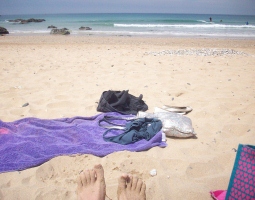
Newquay!
July
So yes. After Newquay, July heralded an emotionally intense week of Torchwood, the weird and wonderful Psychoville, a trip to St Paul’s with bonus marvelling at glass lifts with Sanna, sights-we-never-expected-to-see in Brüno and Saoirse’s birthday pic-a-nic. I extended the goodness of mango beer to Owen, had perplexingly bizarre phone conversations from the top of a night bus, partied to ABBA hits at Lucy’s dinner and – very excitingly – made a pilgrimage to Cadbury World. Oh, and I won the Themes & Sources essay prize! Get in
August
Another aquarium visit was organised for the beginning of August, having been such a big hit in Newquay, before mum, Katie, Lucy and I spent a couple of days in Liverpool: home of the world’s prettiest church (or not). It ain’t summer without a theme park, however – here’s to you, Drayton Manor! – or a family summer holiday, the latter provided by Devon which also gave us a tall(ish) waterfall, scary looking sheep and the opportunity for me to understand at least 50% more references online by watching Fight Club. I also saw The Tempest, again, but with a more-awesome Caliban, and wrote my most popular blog post of the year in statistical terms (by miles) just by being a bit sarky to James Murdoch. But you don’t have to do anything very fancy to have a great time… in fact, one of my fondest memories from the summer is lying on the golf course one night in Queen’s Park, catching up with Matthew and looking up at the stars.
September
September was music month, at least by my rather limited standards. Not only did Abbi gift me tickets for not one but two gigs – Jack’s Mannequin and Twin Atlantic – but there was also Sanna’s melodious chrismation. (Sealed!) No singing in Troilus and Cressida that I remember, but that was also really, really good. Meantime, never far from food and drink, I assisted Lucy in the preparation of a delicious brunch for Abbi and her mum, got totally outclassed by dinner party host extraordinaire Andy, lunched with Philippa, snacked with Nic & Nick2 and went all over the place in the hunt for plentiful food and drink on the day of Saoirse’s rather mobile gathering. But I’m not just a consumer: I also gave blood for the first time in September, too!
October
I got a wonderful chance in early October to relive A-Level English with Ms. Rupchand and Mr. Buchanan, before it was finally time to head back to uni to begin my third and final (!) year. Having admired Lucy’s new house in Brighton I was similarly delighted with my own living arrangements, which finally put me right in the centre of town. And then it was back to work, often in my snug new Caius hoodie, albeit with plenty of distractions and interludes: the wit and wisdom of Ben Stein, the wonder of Windows 7, Merlin and True Blood, swapping halls with Simon, Chris and other Emmanuel folk, swapping blog writing duties with Sanna, Lucy coming to cook us all up a storm, the discovery of the fabled Enchanted Lands of Friendship as well as Katie coming to visit! And the perfect way to enjoy Halloween? Why, Buffy’s Once More, With Feeling, of course.
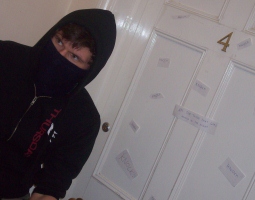
Some things go knock in the night…
November
The Imaginarium of Dr Parnassus came and went as a little ethereal delight; Trinity, on the other hand, could have staggered for a great deal longer if Owen and I hadn’t seen sense and pulled the plug after two episodes. November was NaNoWriMo month, of course, which meant a new slice of Abbi’s heartbreaking novel each morning to read. (More heartbreak was to come with the death of Mr. Bruul, incidentally.) There were also fireworks (but no fairground rides) with Oliver and Abi, a great night in various pubs with Lucy, Simon, Chris, Rob and more and lots of Flight of the Conchords and tea with Owen. I fought (and beat) the Evil Beep Of Doom, rufffed it up at Tom’s birthday party and finally got to a Superhall and a Footlights panto as well as producing my absolute life’s masterwork in Sophie’s birthday video, which was also celebrated with an extravagantly generous meal. Oh, and let’s not forget Caroline’s CUCA dinner 
December
Home, for a suitably relaxing Christmas! Well, that’s what I might have thought, although it soon transpired that my parents had morphed into crime-fighting action heroes with the scars to prove it. I can’t compete, naturally, but I can bake a chocolate cake (alright, with led by Lucy), enjoy mango beer with Sophie and neglect work in favour of parties (Secret Vegetarian Festive etc. etc.), pub gigs (snowy snowy Archway), one utterly inexplicable festive something at the Globe and, of course, Christmas itself! Geeky though it might be, let it be noted for the record that December also saw the end of Windows XP in this house: we live in the future, now  Oh, and talking of which, Katie has very kindly agreed to show me the entirity of the magnificent Battlestar Galactica over the course of the next year…
Wishing everyone a quite fantastic 2010
I’ve just finished The Handmaid’s Tale, which now takes its place as the twelfth and almost certainly the last fiction book I’ll read this year. One a month: it’s not bad, I suppose, even if it doesn’t feel like much. And they were good books!
I don’t have time to write loads, because (a) I have to begin my review of the year before there is no year any more and (b) – the ‘normal’ option – I’ve got to dash off later to rendezvous with Abi, Oliver, Owen (& further unknowns) to see a Christmas show at the Globe, which should be fun fun fun. (Or ‘a family feast of carnival, comedy and Christmas cheer’, if you’d prefer.) So, briefly, two fun festive events! The first was a pub gig this Thursday past with Joshua, Niamh and Simon – situated in Archway, in the middle of a mysteriously byzantine road system and surrounded at the time by a snowstorm – which ended, as you can see, in some inspired dancing:
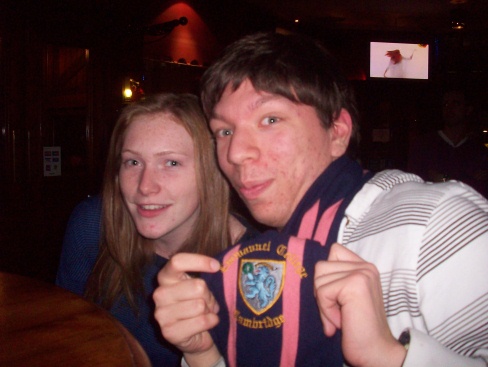
Looksee, a rival college scarf
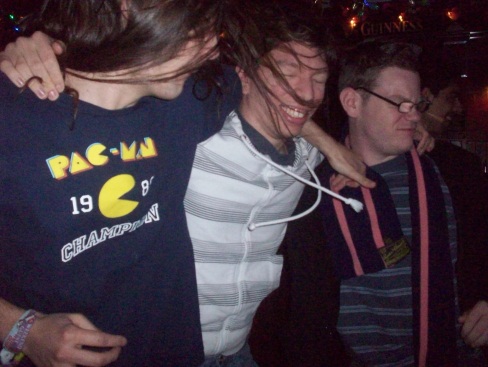
Rage not against the machine, but rather against co-ordination itself
On the way home, after a chip/pita bread detour (tssht, Niamh, hummus is no match for ketchup), a momentous turning-of-the-tectonic-plate-tables took place, wherein the route of the last bus got me home before the Kilburn/Queens Park-dwellers. Mwha! And in fact, the buses were also relatively kind to us coming back from Secret Vegetarian Festive Dinner (Mach II) on Saturday night / Sunday morning. This was a most worthy sequel to last year’s event, once again very generously hosted by Abbi considering the level of carpet destruction which takes place, with another round of Secret Tikoloshe in which I acquired a pleasingly large box of Celebrations from Alice. (Thanks!) I have rather a lot of photos I’d like to include, which normally draws complaints, but please be assured that I could have posted pictures that were a lot, lot worse
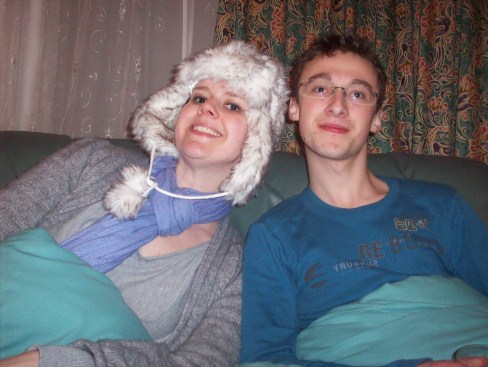
OtherEmily and Robert
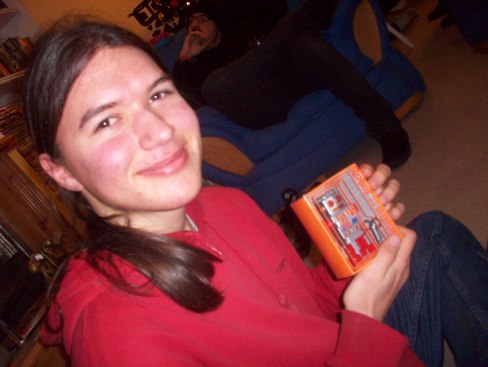
Jakov and Robot
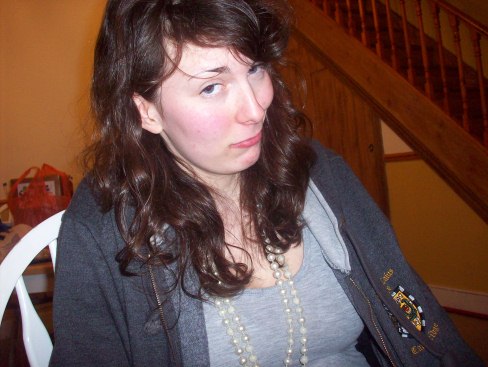
More modelling of Cambridge clothing!
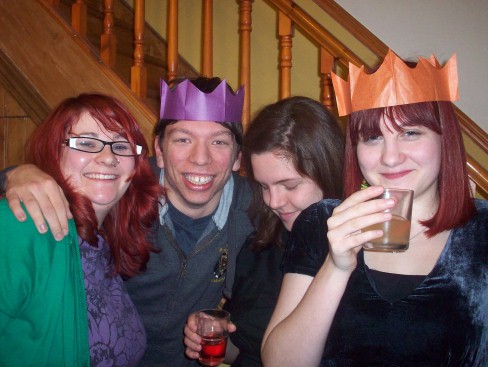
Shiny happy people
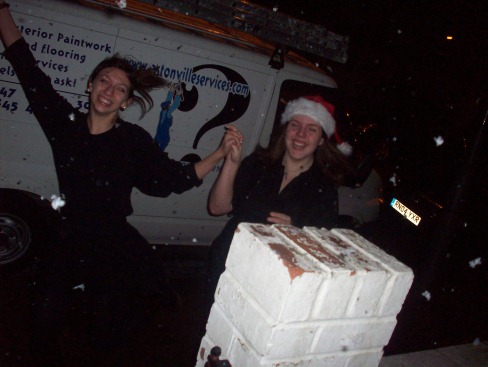
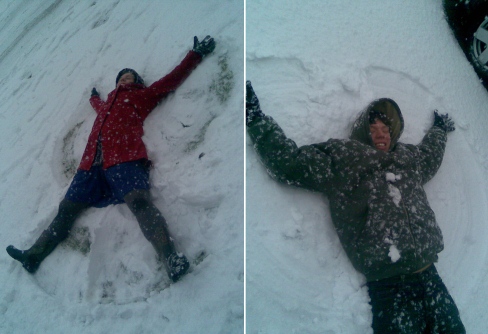
Snow!
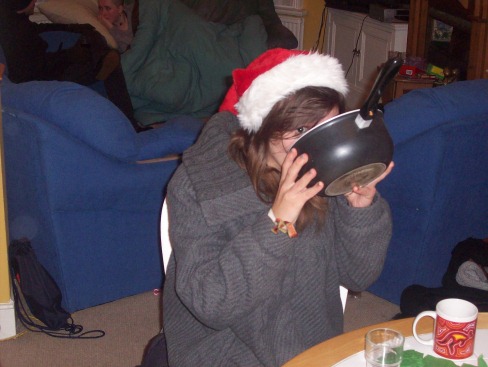
I think this is cute…
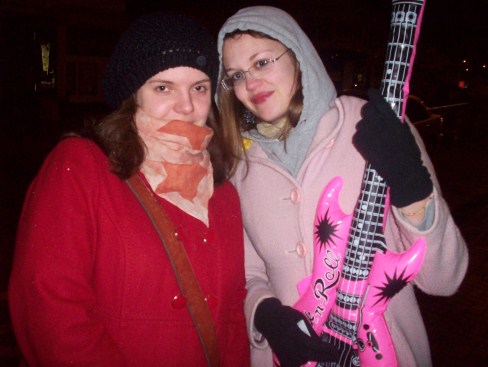
Rage against the machine x2
Christmas is coming, breakfast is at Jack’s
Merlin freed a dragon and Bill Compton’s coming back
Christian’s a space scientist, so here’s a Paradox for you
How are we going to hope without Tennant in Doctor Who?!
I’m still here! And I think I feel like writing a bit of rambling Tashaesque rundown, just to prove that I haven’t been hiding under a rock for the past week. Let’s count down the days…
Monday / Lundi!
Saoirse came over for tea, stayed for supper and tried to sell me TV Tropes for the n-th time. (She is so Badass Bookworm underneath it all… OK, OK, so it is both addictive and good. Like Lady Gaga or licking the baking spoon.)
Tuesday / Dienstag!
Had my traditional “I’m back!” lunch in the Corrib with Joshua. No more needs to be said: this is a tradition par excellence which you mess with at your peril, right down to pretending to scan the menu and then just-so-happening to have a burger. Mm.
Wednesday / Woensdag!
Noooooo… (etc)
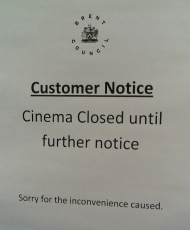
LOOK! (Pssh… over there -> )
That’s right. This was the day I made my fateful discovery that Willesden Green Library Centre is currently cinema-less, the management having apparently ‘disappeared’. Hmmph. This is not acceptable: I don’t mind reading about high street closures on Nic’s blog, but depriving Willesden of a cinema means we’re now officially less cool than Rubery. Rubery! Good thing Lucy arrived on Wednesday, else I would have been tempted to storm the building and set up my own replacement finger puppet light show.
Thursday / गुरुवार!
Lucy and I lunched at the implausibly cheap The Stockpot off Leicester Square before heading to the Science Museum, because we’re obviously both Lovable Nerds. (‘Science’ consisted of random words from the Internet read out in a darkened room in the creepiest voice imaginable, some plastic drapes and a perfectly functioning game table in the glowy bit used to do extremely fun yet educational things.) Then it was off to almost-Hertfordshire for Abi’s house and some Merlin and True Blood, which again can be explained by how very very cool we are. Fun, though
Friday / Fredag!
Oh, it’s alright – Willesden may no longer boast a cinema, but it turns out that it does have a previously undiscovered centre for rather nice milkshakes and cake. Boo yeah – take that, Rubery Smubery. Also of note: The Emperor’s New Groove remains in the top 15% of the ‘good things of the world’ list.
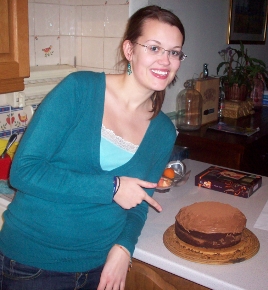
Like Christmas come early
Saturday / Sabato!
The Day Of The Great Cake Project, after Lucy wanted to do some baking and I wanted to do some chocolate cake eating. (I joke, but it should go down in the official record that this was a team effort, and there’s no Lucy-did-all-the-work in team.) Sugar-heavy cake left to cool, we then went to see Carolyn and ended up chillaxing (a word I think I use here because Tasha just walked in about 15 seconds ago) on set with the stars, as Alix prepared a showreel for an exciting audition. If only all films could have London Overground trains going by in the background, and then even bad films would become instantly lovable.
Everyone’s favourite
Sunday / Didòmhnaich!
Touchdown turnaround: Lucy departed for home very shortly before Sophie arrived in the neighbourhood to have dinner with the Selfs. After some tense rounds of Connect 4 and mum’s lovely cooking we headed off to Camden so that I could introduce yet-another-person to ‘mango’ beer, which was met with warm appreciation. In fact, Sophie loved night-time Camden in general, and it’s always nice in general to see London through a fresh pair of eyes. It may be one cinema down, but you just wouldn’t live anywhere else, would you?
I will resist starting a new cycle of the week, but just to note that I also caught up with Sanna today, who was lucky enough to catch the last of the cake before it vanished. Also: as of this morning we are down to a one solitary Windows XP machine, which will itself shortly be extinguished once mum’s shiny new laptop arrives. (Evil Laugh.) Blue may have been the colour of 2001, but it is so, so time to move on. To The Future!




 Linda Moffitt on Colombia: “Such a sweet memory of the four of you meeting up in Colombia!” Dec 2, 07:42