
…as told through Worms. This post is officially dedicated to Jen 

Merlin. In the end, it’s all about the lo-oo-ve!
Sorry I haven’t been up to much real blogging  I did go to a ’30 Years of Women at Caius’ Superhall earlier this week (a Superhall being a much cooler version of normal Hall with fanicer dress but, importantly, also fancier food). Tis true that 30 years is a pretty pathetic milestone to be celebrating, but it was only in 1979 that Caius deigned to lift its bar on, y’know, one half of the entire population of the world. Still, times change…
This post is dedicated to all those who have ever endured the more ‘bollocksy’ end of academia. To everyone else: you may want to just skip to the photos and be done with it.
The birthday party was traditionally understood in terms of a spatially and temporally bounded event, defined as much by its inherent structure as by the agency of the individual actors involved, and generating a narrative which was as much about the party qua the concept of ‘party’ than attempting to set the party in the context of social interplay and culturally specific factors. Over the past twenty years, however, a multitude of new approaches have seen the ‘myth of the birthday party’ attacked on as many fronts. New voices, from the feminist to the post-imperialist, the post-imperalist-feminist and the post-feminist-imperalist, have demanded a new approach: one that is more fluid and open to competing views than the static conceptions of ‘party’ which have gone before. This essay will attempt to explore these recent developments in two parts. First, a brief history of the changing ways in which ‘the birthday party’ can be understood will be analysed, and it will be argued that – although historians have made great bounds in their understanding of some issues – progress has remained, in other areas, patchy and incomplete. Further to this, I shall attempt to use the example of Tom’s Birthday Party (2009) to illustrate the further questions which, I believe, must be asked – as well as suggest some tentative solutions.
Traditionally, narratives of birthday parties tended to follow a rather Whiggish narrative, progressing from the primitive, early stages – the party ‘just getting started’ – until, as events follow their inexorable path, the party is said to be ‘in full swing’, ‘really kicking off’ and suchlike. These assumptions remained largely unchallenged until the 1960s, when historians – particularly of a Marxist inclination – began to poke holes in a logic which seemed on the surface to be all-encompassing but failed to explain, for example, why parties often ended with vomit and tears. Attempting to find answers to these questions, the ‘progress’ narrative was turned on its head: no longer were parties assumed to get ‘better and better’ but, rather, they in fact got worse and worse. Compelling new research was carried out with the aid of previously undiscovered voices. Rather than study the party from the perspective of the bourgeois host or aspirant guests, historians looked to neglected figures in their new narrative of decline: the cleanliness of the carpet, the quality of drunken singing or levels of hand-eye co-ordination.
Such avenues have proved incredibly valuable to the historian since the ‘modernist revolution’, yet questions remained. If a party was no longer a ‘great night’ but rather a sad tale of exploitation, then why did their frequency not diminish over time? Historians of the 1960s and 70s had unearthed many statements of post-party regret – ‘I’ll never drink again’ – and yet a close examination of the sources increasingly revealed that these very same people did, in fact, return to the social domain of the party again and again. And the resurgent fields of economic history in the 1980s led to a growing realisation that previous understanding of the level of capital invested in parties had, most likely, been an under-estimation. People did not simply ‘fight for their right to party’, as the saying goes, but they paid for it too: in the booking of venues, the buying of alcohol and transport costs.
The field of the party became increasingly desperate for a new approach to shed some light on these paradoxes. Ironically – if the word ‘ironically’ is used in its vaguest and least useful sense – this new direction came not from the young turks of the birthday party faculties but through cross-fertilisation with other disciplines. Historians of gender, race and Buffy the Vampire Slayer, for example, had increasingly problematised the idea that concepts such as gender, race or Sarah Michelle Gellar could be understood in a static, uncomplicated way. Often, if read under the new light of post-post-modernism, they were not simply antiquated but absurd. Might these new understandings be applied to the history of the birthday party in a similar way?
Historians who took up the challenge, notably those in the ‘Sussex school’, soon shifted the paradigm away from the ‘birthday party’ and towards the birthday as party, the party as people, the people within the day. Birthday parties, it came to be realised, are neither straightforward progressions nor inexorable declines: they hold up, instead, a fractured mirror to pre-existing social relationships which are then moulded by, and mould, the party itself. Often, these relations lead to conflicts which do not demand a resolution but rather linger in the collective memory for days, months, or even years. And might the party itself thus continue also: no longer with its obvious ties to place and time but rather liberated from them in an ‘imagined community’ of party-goers? This latter suggestion has particularly disturbed the more traditionalist school, who argue – rather unconvincingly – that a party must ‘begin’ and ‘end’ to have any real meaning. But whose beginning, and whose end? That of the host, or hosts? The guests perhaps, or maybe those who ‘maybe attended’ in the Facebook event record? We cannot simply shut the door on the truth, as unpalatable as it might be, that there is no truth but only ‘truths’, and only within inverted commas.
I turn, now, to Tom’s birthday party of last night. In keeping with the approach suggested above, I will not attempt to provide a ‘grand narrative’ of the proceedings but rather outline a number of sites of interest. The theme was, in so far as a theme can be ‘imposed’ from above, that of ‘ruffs and cod-pieces’. ‘It’ was really lovely ‘to’ ‘see’ the fetching ‘hosts’ of ‘Tom’ and ‘Lucy’, as well ‘as’ ‘Irfan’ ‘who’ ‘made’ ‘a’ ‘much’ ”anticipated” ”’appearance”’. ‘Also’, ‘my’ ”college” ”’mother”’ was ‘there’! (By ‘the’ ””’end””’ I was ‘also’ more ”than” ‘fully’ impressed by the ‘cheesy’ music ‘which’ had managed to ”appear”, and ‘not’ ”largely” by my own ‘prompting’. I mean, dear ‘old’ ”Scatman”, and the ‘Hampster Dance’? ‘Hurrah!’)
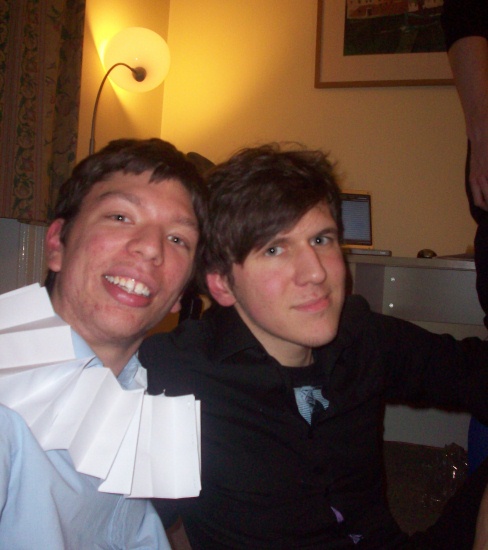
Fig. 1. Dominic and Owen. Note the loose conception of ‘ruff’.
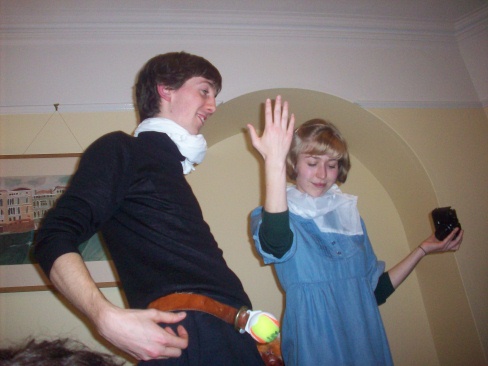
Fig. 2. Tom and Lucy celebrate
Fig. 3. (I have a really nice photo of these two, but I won’t use it, because all academics are bitter and twisted deep down.)

Sheltering from the beeping
Here I am, in my temporary refuge of my spare room. I’ve been driven out from my actual room by an evil beeping noise which has been going on for several days and, once it was brought to my attention, was threatening to drive me psychotic. Today I took emergency action, not only hiding in here but also going around potential candidate buildings and phoning up their owners trying to get a fix on my nemesis.
Until then, I shall reside here. It’s quite nice. There’s even an unsecured wireless network to piggyback on (ssshhh). Still. I miss my old, beep-free room. 

Right, now that Owen and I have finished spending another witching hour sipping tea and chatting about stuff – mostly agreeing, sometimes not – I feel it is time to blog. Starting with some photos from Fireworks Night, which Tash will be glad to hear we observed through attendance at the council’s big public firework display! (I always forget about the duty of organising firework displays when critiquing the impotence of local councils. Silly me.) And honestly, I do wholeheartedly forgive Oliver and Abi for not wanting to go on the fairground rides, but I do now feel I am owed a roller coaster or two by Fate. Make it happen, K?
Oliver is secure in the knowledge that my enthusiasm for the rides is in a distinct minority

Pretty fireworks, though!

“Don’t you wanna know how we keep starting fires?”
And now a brief interlude from show and tell to enthuse a little bit about work. Yeah, work may always be’ work’, but it also forms the final year in which the state will be fooled into sponsoring me to read about the motivations of the All-India Muslim League, or Hegel, or the letters that John and Abigail Adams wrote to each other. And on this final point – my Special Subject is actually fun. I mean, I’m just nosy and enjoy reading people’s private letters, mmkay? Especially when they turn rather silly and fun, like when they have stupidly decided to list each others’ faults (don’t ever do this) and John notes with annoyance that Abigail has a habit of sitting with her legs crossed. Still, I guess if this is the best that you can come up with your marriage is probably sound. (No emoticons, though. It’s not true love.)
Talking of true love…

(We weren’t even drunk by this point…)
I think Simon and I are now just playing up to Sanna’s vaguely homoerotic blog post on the subject. But anyway, the above photo was part of a hugely entertaining pub ‘crawl’ (of, ahem, two pubs) embarked upon by Lucy and I with Simon, Chris, Rob and several others. (I’m in a bind now, because whilst ‘and several others’ sounds rude – sorry! – Rob objects to being lumped in with ‘That Emma Lot’ – sorry! – and a long list of names is hardly conducive to anything outside of war memorials and firing squads. Sorry.) Twas lots of fun, although it’s always somewhat risky to mix beer with rosé. (Manly rosé. We made this clear.) More photos, as the saying goes, on Facebook.
Oh, and as Lucy noted, we walked past Father Alexander (of chrismation fame) the other night. Maybe it was our Pizza Hut smell, the encroaching darkness, persistent rain or the fact that he was fully engaged in conversation at the time, but we didn’t stop to chat. If he’s reading, though – and of course, he isn’t – he’s more than welcome to stop by for tea sometime 

Opening note for those who never leave the world of RSS: it seems that the effects of NaNoWriMo have given Daylight Atheism and Nic a free run over my Feed Mix…
Greetings, blog readers who still have time to do any blog reading! I’ll kick off with Katie’s visit to see me on Friday and Saturday, which I imagine was one of her first interactions with the fiendish process of buying National Rail tickets. It’s actually one of the underlying physical laws of the universe that this is impossible to get entirely right on your first go, but I think Katie deserves official salutations for managing to persuade a London Underground ticket machine to sell her a London Underground ticket to Cambridge at what was seemingly a completely made-up price. Obviously, I’ve underestimated TfL’s sprawling reach… the appearance of Cambridge on the tube map is, clearly, only a matter of time now. Anyway, Katie’s visit was lovely, and we did the essential library tour (sans the UL, which refused to let her in), watched the Sarah Jane Adventures (sshh, sshh), did formal Caius hall just for the lolz and battled across the varying terrains of Worms 3D and Peggle Nights. Oh, and don’t forget the waffles 
Actually masking deep disappointment that the candles aren’t floating in the air

An act of deep rebellion: standing on the grass!
Now… don’t hate me, but I’ve never really been much of a fan of Halloween. (Although this is apathy rather than some kind of puritanical hatred – don’t worry, you don’t have to fight for your right to party.) I am greatly impressed by the various amazing costumes on show, but still failed to join their ranks this year. However, on the freaky-scary scale (named after its inventor, Dr. Freaky Scary), watching Uther’s – *cough* – intimate encounters with a troll on Merlin surely ranks about a 9. We also went to see the ever-fantastic musical episode of Buffy at Caius FilmSoc, which always makes me wish that real life could also encompass frequent bouts of well-choreographed singing.
(Omg – you can buy the Once More, With Feeling soundtrack online? That’s almost as good!)
To continue my theme, albeit with a newly present Buffy soundtrack in the background, last night Oliver, Abi, Owen and I saw The Imaginarium of Dr Parnassus, which (all but one of us agreed) was really enjoyable. It perhaps didn’t have the strongest feminist undertone in the whole entire world, and once again the Devil continues to get a really unfair press (I kid, I kid), but it was beautiful, fun and my attention didn’t lag once throughout. So naturally I don’t want to say any more about it, because praise is rather boring compared to criticism and as of last night I also have a new favourite laughable bad TV drama: ITV2’s Trinity.
Trinity‘s basic premise is as follows: Trinity college – not technically of either Oxford or Cambridge but clearly intended as an Oxbridge institution – has been forced to admit some proles alongside its usual contingent of stupid posh twats. They clash. But! Underneath is an exciting (well, not really) conspiracy involving murder most foul, secret overlords, etc etc etc. The execution of these already rather weak ideas is, however, grotesquely awful to the point of being utterly hilarious as well as not actually making any sense. (An example of dialogue, roughly: “I’m from Lewisham.” “My uncle owns Lewisham!”)
Just in case anyone has any doubts about Oxbridge, I feel compelled to reassure you of the following: graduation mortarboards are not inexplicably worn all the bloody time, grace – if said at all – is not divvied up line by line to each student so that poor people can be laughed at for not knowing Latin, champagne is drunk rather than poured over oneself, medical students are not instructed to work ‘through the night’ alone in a creepy basement with appropriately flickering lights and beds are (sadly) not of the four-poster satin-sheet variety.
But I’m not particularly worried, since Trinity seems to exist largely to confirm prejudices about ITV2 rather than Oxbridge. The biggest problem – or rather, source of much mirth – is that the characters consistently display a strange lack of ability to remember what their own personalities are supposed to be. Take Charlotte. We are repeatedly and unsubtly reminded that Charlotte is a chaste Christian girl who deeply disapproves of sex ‘n’ stuff. And by ‘unsubtly’, I mean such as through scenes like this:
[Shot of a big wooden cruifix on the wall, and the sound of an organ, cut back to Charlotte who also always wears a crucifix around her neck]Charlotte: I am a Christian, yes…
Three of her friends in unison: We’re Christians!
And yet! In the very first episode, Charlotte is so traumatised\turned-on by the sight of her dead father apparently still alive that she runs into the arms of the leader of the posh twatty boys, immediately sleeps with him and breathlessly declares – in what is surely a new triumph for realistic dialogue – “wow… is it always that good?!”. Post-coital bliss isn’t long lasting, however, as she absent-mindedly plays with the crucifix around her neck before seemingly remembering her whole identify and snapping back into pious, now-really-quite-indigent mode.

Oh… shit! I knew I forgot something!
(It’s the equivalent of me getting halfway through my own Christmation before remembering through that, wait – dammit, I knew there was something – I’m actually an atheist! And do bear in mind, any TV series that gets me going on for this long about unfair portrayal of Christians has to be pretty damn bad…)
Anyway, if after Trinity you’re desperate for some actual good storytelling, then I wholeheartedly suggest Abbi’s NaNoWriMo novel. Already it’s proving an absolute pleasure to have another instalment ready to read each morning, and the donation required for access goes entirely to children’s charity Barnardo’s. So just go and do it: donate, read and enjoy!


 Linda Moffitt on Colombia: “Such a sweet memory of the four of you meeting up in Colombia!” Dec 2, 07:42


