The very good thing about having done exams is that I now feel entirely guiltless about living a rather luxurious and indulgent lifestyle for the summer  Following the urge to escape Cambridge for a couple of days, I was in Sussex to see Lucy earlier this week, before coming up to London to take my mum out on her birthday present: Amongst Friends at the Hampstead Theatre. And the next night I was lucky enough to see Waiting for Godot – courtesy of Helen‘s generosity! – starring (wait for it) Patrick Stewart and Ian McKellen. Which, let’s be honest, is going to make anything worth it. I’m still rather intrigued about what to make of the play itself, and I wish I could call back upon my A-Level English class for help
Have now returned to Cambridge for a few days of garden parties, drinks and visits to the fair (minus the sheep show, which didn’t appeal greatly) before coming home properly. As ever, it’ll be wonderful to hang out with everyone back home again, safe in the knowledge that I still have another year before I actually have to join real life. Can’t wait for Newquay!
So here we are – it’s the night before my last exam. It’s the History of Political Thought to c.1700 paper, which is unusual in the sense that we are guaranteed a question on each specified topic, so I can be certain that tomorrow I’ll be answering questions on Plato, Hobbes and International Law. I’m choosing to interrupt quote-learning for blogging, however, because it’s quite possible that immediately after the exam I’ll enter a euphoric haze that could last for quite a while. Plus I have a rather fun and exciting week lined up, so blogging there may be little!
Waking up to dismal European election results put me in a thoroughly bad mood this morning, albeit solely on the BNP angle. I don’t really mind Tory or even UKIP success with the same gut instinct: after all, there is a common community of political junkies which (I presume) works in a similar way that football fans do. Labour are my tribal ‘team’, and I am bitterly disappointed when they lose on occasions that I really and sincerely don’t believe they deserve to, of which Ken’s defeat is a classic example. But at other times, I think the grinding demands of the political cycle are overwhelming, and oddly enough I feel worse about lack of sizeable Lib Dem or Green gains than Labour’s losses. (Maybe not so oddly: I did vote Green in this election after all.)
In common with the vast majority of people, however, I feel nothing but disgust for the BNP and find any gain on their behalf deeply upsetting. Lucy put it perfectly this morning, and there isn’t really anything to add, but I would say that some of the reassurances we are offered about the far right do nothing to reassure me because they miss the point. No one is expecting the BNP to ever wield effective political power. (Unless there is some major social breakdown, of course, but then all bets are off.) It is perfectly true that very many more people are ‘anti-BNP’ than support it. But it is wishful thinking to believe that ‘anti-BNP’ carries much ideological commitment beyond a distaste for racism. Plenty of people who will never vote BNP nevertheless carry strong reservations about immigration and multiculturalism, even if this is more often just a vague feeling of dissatisfaction rather than a vote-influencing political priority.
And with every gain of the far-right, the temptation to shirk from an active defence of immigration and multiculturalism in favour of ‘tough’ rhetoric becomes ever greater. This will be admirably justified as reaching out and listening to the poor and disaffected, but it merely serves to implicitly confirm the premise that, under all of the nasty racism, the BNP do have a bit of a point.
Well, they don’t. And you might say that I’m bound to say this, given my support for a particularly multicultural vision of what Britain ought to be. It’s true: I do firmly believe that a multicultural society is by far a stronger one. But that’s not my point here. Even if you don’t agree, it is important to accept that BNP policies – or BNP-lite imitation policies – are utterly irrelevant to the real problems at hand. Attempting to change the precise number and composition of individuals in this country will not create jobs, build houses or improve service provision. Whether your neighbour is a Turkish Muslim or a Catholic Pole, you will all look remarkably similar if caught underneath rising sea levels or the blast of a terrorist bomb. The ‘planned economy’ character of a points-based immigration system is bad enough, but let’s not fall any further down this ultimately deeply diversionary route. It’s not just wrong – it’s shamefully neglectful of all of the people who need real help for their problems, not false words.
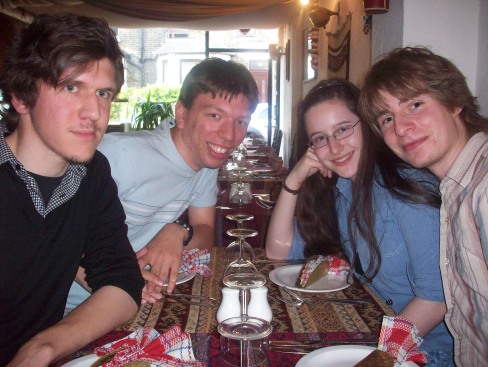
With four exams down and only one left to go – next Tuesday – there’s been a bit of breathing space for those odd little fragments of life which don’t revolve around exams. We all had an especially good excuse yesterday, Abi’s birthday, and so went out for a (delicious) meal and drinks together with Abi’s friend Heather who is over here visiting from California. (It’s occasions like these where those bits of California knowledge suddenly become very important, such the desolate nature of Fresno – sorry, Fresno – or the fact that Maine is now, quite shockingly, officially cooler than California.) And I have to say, I do rather love this supremely well-posed group photo:
Out for Abi’s birthday
Today Owen, Abi, Heather and I went punting, although by some fluke of sheer charm (clearly) we persuaded Owen to do the actual punting whilst the rest of us relaxed. And drank cider. Cambridge really does veer between the extremes of work and relaxation, doesn’t it? Still, it’s becoming increasingly clear with every frantic zig-zag between the river bank why the punt never quite caught on in the rest of the world outside Oxford and Cambridge.
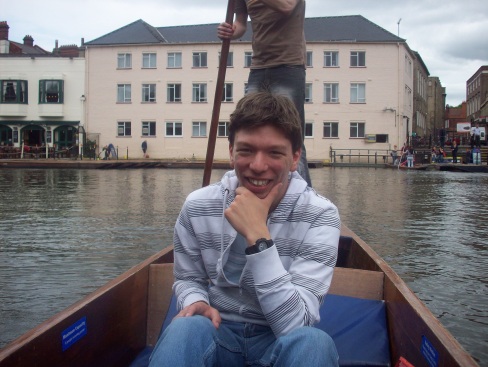
Owen punts us along (I don’t…)
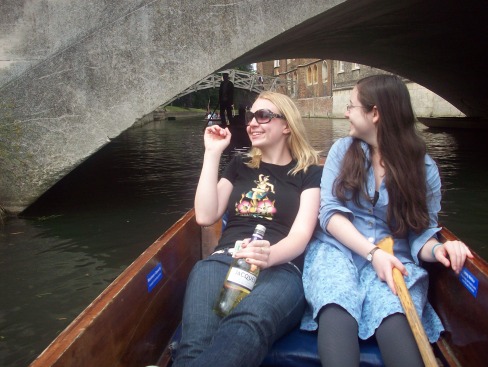
Heather and Abi
Fun musical mix-up moments: a classical Dancing Queen, German Lion King and a punky Apologize. Spotify required.

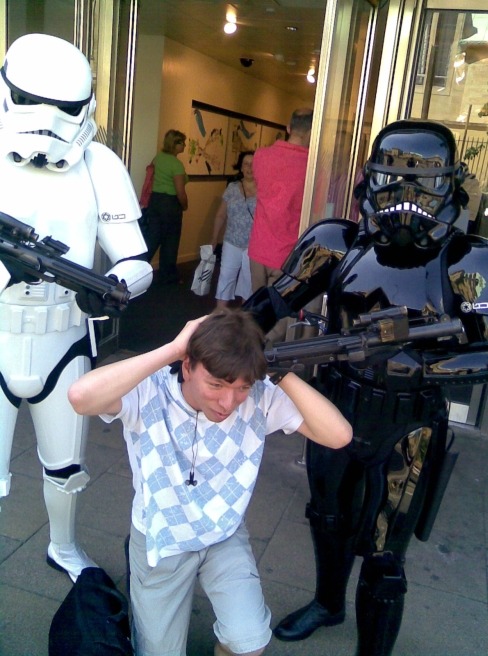
Stormtroopers!
Clearly, Cambridge is being used as a pilot area for a tough new government policing project…
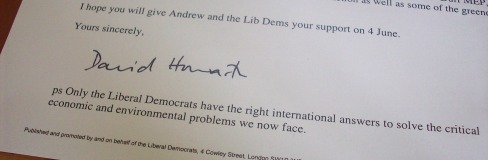
This is not a footnote:
Not a footnote
Acceptable examples of footnotes include ‘still up for Friday?’, ‘sorry for being so slow to reply’ or ‘and you were rubbish in bed too’. It’s not for grandiose claims: they at least deserve a paragraph or two in the main body of the text. Did Lincoln end the Gettysburg Address with ‘P.S. We should remember that all men are created equal’? I very much think not. Did Hitler end Mein Kampf with a quick ‘And you know who I blame for all of this? The Jews…’ in the afterword?
Talking of Hitler, after watching the reassuringly awful attempt by the BNP to appeal to children, I think I have found a worthy successor to Abbi’s urge to add ‘with the furrrr’ onto the end of things. Y’see, in the video, ‘Billy Brit’ (to which one should of course add ‘the racist shit’) recites an excruciating poem celebrating his ‘heroes’ and rounding off each stanza with ‘and he was white!‘. I now have a habit of appending this to everything. To use the top BBC News headline as an example: ‘Conservative MP Bill Cash has “very serious questions to answer” about his expenses, says David Cameron. And he was white!’





 Linda Moffitt on Colombia: “Such a sweet memory of the four of you meeting up in Colombia!” Dec 2, 07:42